Getting to Burana from Bishkek
The tower is about 80 km east of Bishkek, a drive of about 1.5 hours on paved roads, and about 10–12 km south of the town of Tokmok. On the way to Issyk-Kul or Chon-Kemin it is a detour of roughly 30 km and 45 minutes of driving.
By public transport, take marshrutka 353 or another 300-series minibus from Bishkek's Eastern Bus Station to Tokmok, about an hour and about 100 som in 2025–2026. From Tokmok, marshrutka 212 runs to the gate for about 50 som, roughly once an hour, or you take a taxi for the last stretch.
The tower
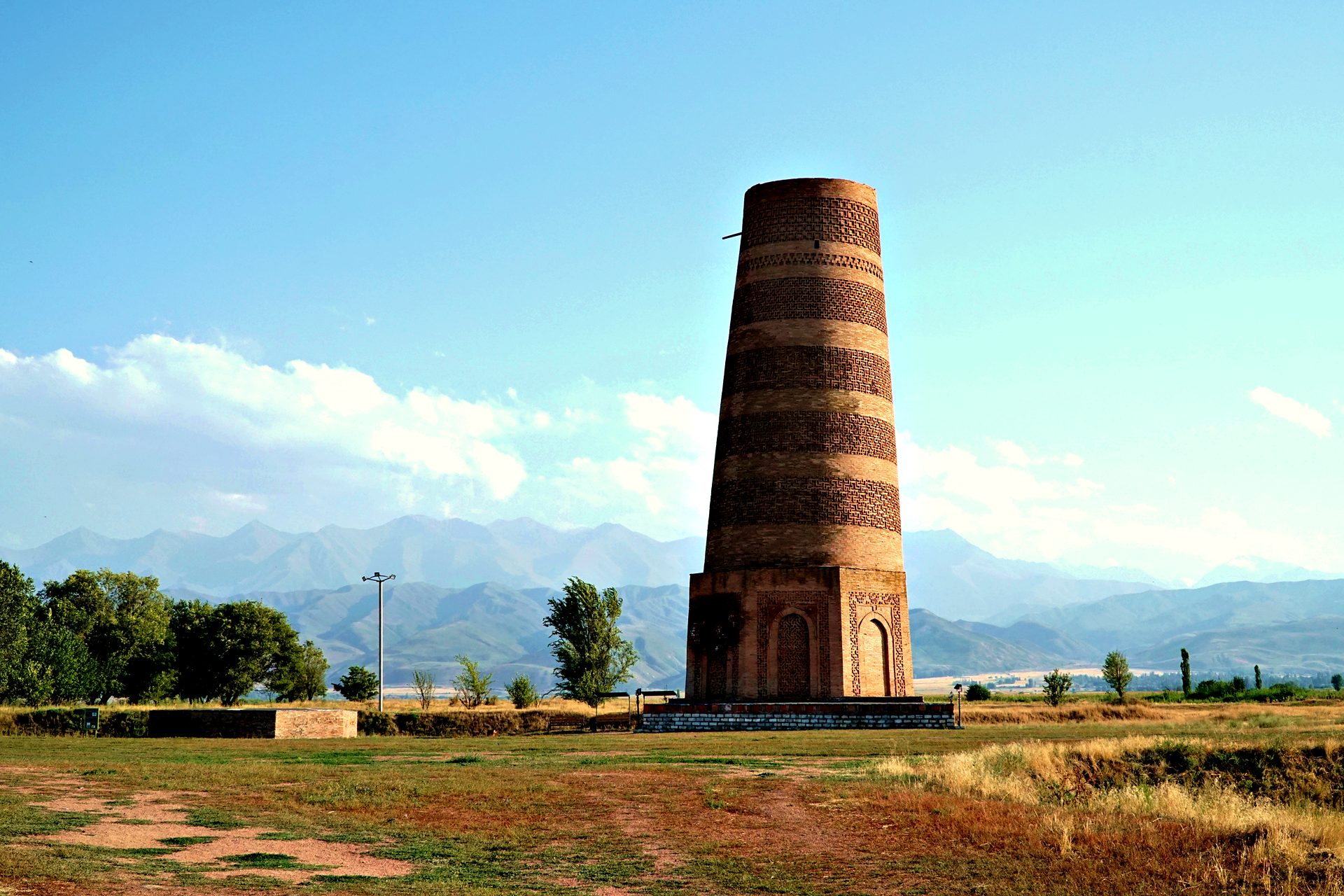
The tower was the minaret of the main mosque of Balasagun, built by the Karakhanids around the turn of the 11th century. It is made of burnt brick on a square stone base, with an eight-sided plinth and a round, tapering shaft banded with patterned brickwork.
It once stood an estimated 40–45 m high. An earthquake, probably in the 15th century, brought down the upper half, and what you see today is about 24 m. The tower was restored in 1927–28 and again in the 1970s, and a conservation project in 2021–2023 renewed the surface at the top.
You can climb it. An outside metal staircase leads to a door on the south face, and from there a spiral stair goes to the top. It is dark, steep and wide enough for one person, and the same stair is used going up and coming down. Bring a phone torch, and skip it if you dislike tight spaces. In winter the steps can be slippery.
What else is on the site
- Balbals: a field of carved stone figures, early medieval Turkic grave markers from roughly the 6th–10th century. They were brought here from elsewhere and set out as an open-air collection.
- Petroglyph stones and millstones: boulders carved with animals and hunting scenes, also brought in from other places.
- Mausoleums: the restored foundations of three mausoleums east of the tower, from the 11th–12th centuries.
- The mound: a grassy hill about 10 m high beside the tower, the remains of a citadel or palace. From the top you can make out the lines of the old town walls in the fields.
- The museum: a small building near the entrance with pottery, coins and other finds, and photographs of the tower before restoration. It is included in the ticket.
Balasagun and UNESCO
Burana is generally identified with Balasagun, a capital of the Karakhanid state on the Silk Road. The city came under Mongol rule in 1218 and had faded away by the 14th century. The poet Yusuf Balasaguni, author of the Kutadgu Bilig, was born here.
Since 2014 the site has been part of the UNESCO World Heritage listing "Silk Roads: the Routes Network of Chang'an-Tianshan Corridor", under the name "City of Balasagun (Site of Burana)". The two other Kyrgyz parts of that listing, Ak-Beshim and Krasnaya Rechka, lie in the same valley.
The legend of the khan's daughter
Local legend says a khan built the tower to protect his daughter from a prophecy that she would die at 16. A spider hidden in a basket of grapes killed her anyway, and his grief brought down the top of the tower. Historians are less romantic: it was a minaret.
Visiting: fee, hours and when to go
- Ticket: about 220 som for foreign visitors in 2025–2026, one ticket for the tower, the grounds and the museum. Cash only, and small notes help.
- Hours: usually 09:00–17:00, every day.
- Crowds: tour groups arrive from about 10:00, and the queue for the stair builds with them. Come at opening if you can.
- Sun and water: there is almost no shade and nothing to eat or drink for sale. Bring water and a hat.
- Season: the site is low, at about 940 m, and open all year. Spring and autumn are the most comfortable; midsummer is hot.
- Facilities: basic toilets on site.